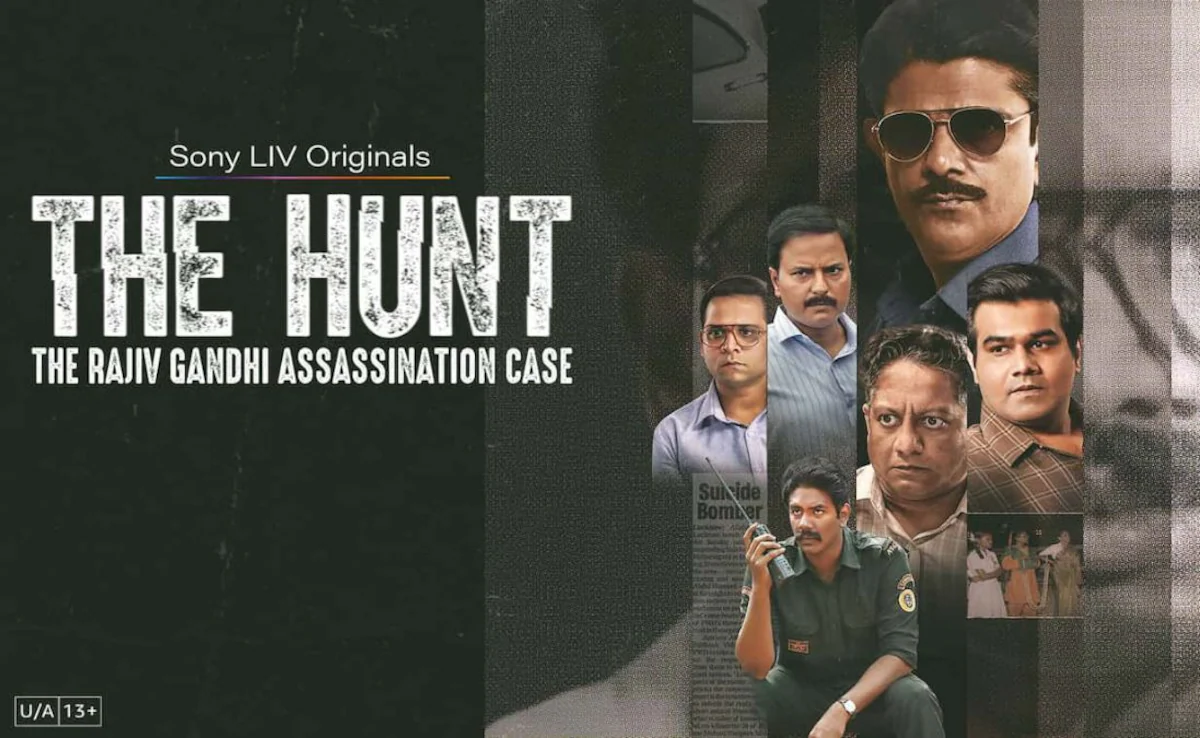
On July 4, 2025, SonyLIV dropped The Hunt: The Rajiv Gandhi Assassination Case — an intriguing seven-episode crime drama directed by Nagesh Kukunoor. Inspired by Anirudhya Mitra’s best-seller Ninety Days, the show brings the fear of May 21, 1991, where ex Prime Minister Rajiv Gandhi was murdered in Sriperumbudur and the high-octane manhunt across 90 days that was carried out throughout the whole country to find the assassination assassins.
Explosive Beginning: The Assassination
Using real footage and meticulously reconstructed scenes, the series jumps right in to dramatize the fatal explosion outside Gandhi’s campaign rally. The assassin — who went by the name Dhanu — was a suicide bomber disguised as someone carrying a flower garland. And it was part of a carefully planned LTTE operation that killed not just Rajiv Gandhi but also 15 others. The series does a gripping job with this harrowing moment, and with its visceral weight.
The Manhunt: A Team on the Trail
The narrative is told from the perspective of the Special Investigation Team (SIT), headed by CBI officer D.R. Karthikeyan, played with a nervous intensity by Amit Sial. He is backed by Sahil Vaid as Tamil-speaking IPS officer Amit Verma, Danish Iqbal as Amod Kanth, Bhagavathi Perumal as Ragothaman, Vidyuth Gargi as NSG Captain Ravindran, Girish Sharma as DIG Radhavind Raju. This dedicated crew pursues the conspirators using both typical police tactics and cross-border intelligence.
But who should save the evening but “One-Eye Jack”? — The Brain-Russian.
The plot was engineered by Sivarasan, alias “One-Eyed Jack,” on behalf of the LTTE. A Sri Lankan Tamil well acquainted with Indian territories becomes a specter, a ghost in the flashbacks disclosing the chillingly detailed plan of assassination of Gandhi.
Realism in Procedural Storytelling
The series has been described as grounded. NDTV dismisses it as an “engaging, taut period thriller” that manages to keep the focus squarely on the investigation. The Indian Express emphasises that the show gives a ringside peek into the punishing world of real-life detection. Although engaging, a few reviewers note that the dramatized, script-based delivery can sometimes lack the raw emotion of a documentary narrative.
Controversy & Context: What’s In and Out
Though The Hunt includes plenty of prolonged interrogations and battles over bureaucracy, it purposefully steers clear of such knotty, disputed elements as supposed political conspiracies and intelligence blundering. It fits in snugly along SIT’s timeline of the case, and public facts the agency has verified, skillfully dancing between drama and restraint.
Post-Release Piracy Threat
Even though The Hunt had some of the best production values, it couldn’t escape the fang of piracy as it got leaked on websites like Filmyzilla within hours of its release. The incident highlights the increasing problem of piracy in India — something that is evident from OTT platform hits like Panchayat Season 4 and Squid Game Season 3, among others. Experts within the industry recommended that those who wanted to see the series should do so through legal means and on legitimate platforms.
Why This Story Still Resonates
- Emotional Legacy: The assassination of Rajiv Gandhi is still a festering wound in the collective memory of India. Approaching it as drama, albeit sensitive and dramatized, puts us back in a national reflective frame of mind.
- Two Decades of Courtroom Battle: The extended prosecution — including A.G. Perarivalan’s life sentence, and the contentious 2022 release of him, a supplier of bomb components — has kept the case alive in public conversations.
- Cinematic and Educational Value: For those unfamiliar with India’s political history, The Hunt is an educational yet gripping introduction to a turbulent chapter in the country’s past.
The Real Investigation: Major Breakthroughs
Led by D.R. Karthikeyan, the mission to hunt down Sivarasan’s gang was extended to South India and Sri Lanka. In a key breakthrough, Karnataka police tracked LTTE agents resulting in some of them consuming a cyanide capsule rather than face arrest. A mix of phone intercepts, witness descriptions and critical forensic evidence — including a rediscovered camera that led to key clues — helped lead to the success of the investigation.
Series vs. Reality: What the Show Left Out
- Propaganda Theatre: The audience is deliberately led away from even darker suspicions that domestic politicians or intelligence agencies may have been complicit or culpably negligent.
- The broader global context:
- It is the LTTE which has been definitely identified as the main guilty party, but some “experts” disagree granting dynamic the state system in SL.
- There is a broader context within which the LTTE can be understood and other agents found to be responsible for the chain of events. The Hunt does not want to look into any of this and it would rather communications come from a procedural angle.
Reception and Cultural Impact
Receiving rave reviews and edge-of-your-seat suspense, The Hunt is fast emerging as one of the flagship titles for SonyLIV — though its potential reach has undoubtedly been muddied by piracy. Its grounded storytelling emphasizes the universal allure of true-crime stories and historical dramas based on real-life investigations.
Broader Historical Insight
- Rajiv Gandhi’s Legacy: His role in Indian politics — and especially his decision to deploy the Indian Peace Keeping Force to Sri Lanka — transformed him into a controversial figure in the South Asian neighbourhood and a target for the LTTE.
- LTTE’s Motivation: The Sri Lankan Tamil separatist organisation perceived Gandhi’s second coming as a deterrent to their ambitions, which reinforced their determination to kill him.
- Security Fallout: The assassination prompted a relook at national security protocols leading to enhanced SPG (Special Protection Group) cover for the Gandhi family and top leaders.
Final Analysis
The Hunt isn’t just dramatized tragedy — it’s a careful re-examination of one of the darkest chapters in modern India. With strong performances, lean storytelling and deep emotion, the series is infused with new urgency in a case that many — but not everyone — had considered closed. An investigation grounded in the smells and sounds and minute-to-minute choices of one detective, it steers clear of some of the more conspiratorial byways — but is an exquisitely disciplined snap-to-attention march of an investigation living so deep in the moment, it can’t even see the moment. With its obsessiveness on exactly when one call was made, it risks repetition; instead, it turns the investigation into a constant shift of focus, an aural corroboration of a new kind of continuity editing, all about what stays the same and what changes.
✅ The Verdict
Must-Watch for fans of history and thrillers: A gripping, well-researched exploration of one of India’s most astonishing political crimes.
Highlights: Firm pacing, ensemble acting at its best and a lushly realized early-’90s backdrop.
Warning: Avoid piracy. Support legal viewing platforms. There would have been more to mine in politics.
In Closing
The Hunt: The Rajiv Gandhi Assassination Case contextualises and transforms our perception of a moment that shaped modern India. This SonyLIV series, that moves from Sriperumbudur to international conspiracies, reminds us that the hunt for the truth isn’t only about smoking gun evidence, it’s also about memories that are too stubborn to evaporate.
Now streaming, if you haven’t checked it out yet. If you do watch it through proper legal channels, enjoy the art and remember the human ache the tragedy created.