The passing of veteran Bollywood figure Zarine Khan, wife of actor-director Sanjay Khan, has stirred conversation—not just for the loss itself but for the way her final rites were conducted. Zarine, who passed away at 81 due to cardiac arrest in Mumbai, was cremated according to Hindu customs. This decision sparked curiosity and discussions across social media and news platforms.
The news of her demise also reignited conversations about how public figures often become symbols of larger societal discussions, especially in a country like India where religion, culture, and identity are deeply intertwined. Many people were not only mourning her passing but also trying to understand the cultural context behind the rituals performed. For some, the ceremony became a reflection of changing social norms, while for others, it raised questions about tradition and religious boundaries. In a society where personal choices are increasingly being voiced, Zarine Khan’s final rites became a topic that went beyond a single family’s decision.
Additionally, the attention given to her funeral highlights how celebrity lives—and deaths—often attract scrutiny. While private individuals may make similar decisions without public discussion, high-profile families tend to face widespread analysis. This incident underscores how societal expectations can sometimes clash with personal choices, especially when they are visible to millions. The debate that followed her passing reflects the evolving mindset of modern India, where traditions are both respected and questioned.
The Funeral
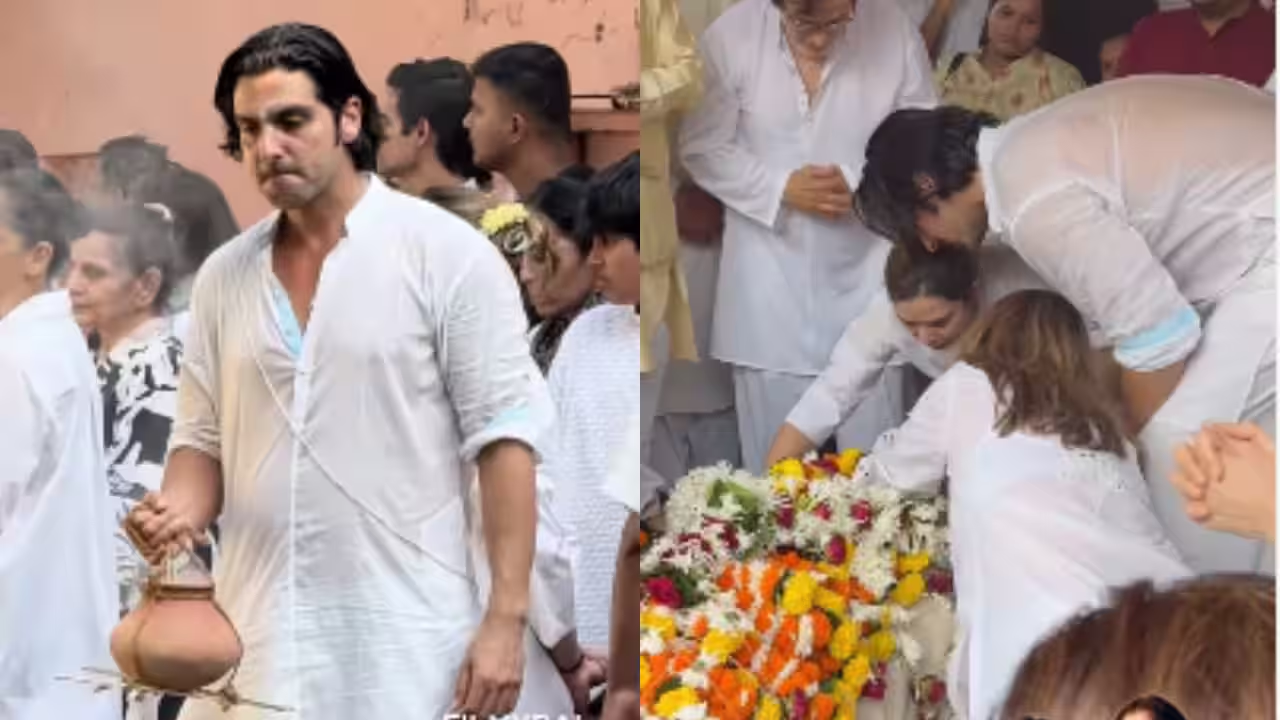
On the day of her passing, Zarine Khan’s last rites followed Hindu rituals. Her son, Zayed Khan, led the ceremony, performing traditional cremation rites, including placing the clay pot (kamandalu) and other rituals associated with a Hindu dah-sanskar.
Prominent Bollywood figures attended, including Hrithik Roshan, former husband of her daughter Sussanne Khan, and other family members, many of whom were visibly emotional. Videos and photos captured Zayed Khan breaking down during the rites, highlighting the personal and emotional significance of the moment.
The atmosphere at the cremation ground was filled with grief, silence, and a sense of deep personal loss as family members gathered to bid their final farewell. The rituals were carried out with sincerity and devotion, reflecting not just a religious ceremony but an emotional tribute to a mother, wife, and guiding figure. As per Hindu traditions, the body was placed on the funeral pyre, adorned with flowers and sacred offerings. Priests chanted mantras, creating a spiritual environment that emphasized peace and liberation of the soul.
Zayed Khan, as the son, took on the responsibility of performing the last rites, which hold significant meaning in Hindu culture. The act of lighting the pyre is considered one of the most important duties of a child, symbolizing the release of the soul from the physical body. Witnesses present at the ceremony described the moment as deeply emotional, with Zayed visibly struggling to hold back tears. His actions reflected both cultural duty and personal grief, blending tradition with heartfelt loss.
The presence of extended family members and close friends further emphasized the emotional weight of the occasion. Rituals such as circumambulating the pyre and offering prayers for peace were performed, each step representing centuries-old customs designed to guide the departed soul. The ceremony was not only about mourning but also about celebrating a life lived with dignity, love, and resilience.
Observers noted that despite public attention, the family maintained a sense of privacy and dignity throughout the proceedings. The rituals were conducted with simplicity rather than grandeur, focusing on spiritual meaning rather than external display. This approach resonated with many who believe that funerals are deeply personal moments that should prioritize emotional connection over societal expectations.
Why Hindu Rituals Were Chosen
The choice of Hindu rituals raised questions due to Zarine’s marriage into a Muslim family. Reports clarify that Zarine never converted to Islam and retained her original faith throughout her life. Born Zarine Katrak, she came from a Parsi family but was reportedly raised in an environment influenced by Hindu practices.
Her children explained that she was:
- Born a Parsi
- Married a Muslim
- Cremated according to Hindu rites
This highlighted the family’s intention to honor her personal wishes and cultural roots.
The decision to conduct the funeral according to Hindu customs reflects the complex and layered nature of identity in India, where individuals often draw from multiple cultural and spiritual influences. Zarine Khan’s life journey itself was an example of this diversity, having been born into a Parsi family, married into a Muslim household, and living in a society where Hindu traditions are deeply ingrained in daily life.
Family sources emphasized that the choice of Hindu rites was not made arbitrarily but was rooted in her personal beliefs and preferences. Over the years, she had reportedly developed a strong connection with Hindu practices, participating in rituals, observing festivals, and following spiritual customs that resonated with her worldview. For the family, honoring these preferences was more important than conforming to any external expectations.
In many interfaith families, religious identity is not always defined by rigid boundaries. Instead, it evolves over time, influenced by personal experiences, relationships, and individual beliefs. Zarine Khan’s case reflects this fluidity, showing how a person can embrace aspects of different traditions without being confined to a single label. This perspective challenges the conventional notion that marriage automatically dictates one’s religious identity.
The family’s decision also highlights the importance of consent and personal choice in matters of faith. In contemporary society, there is a growing recognition that individuals have the right to define their own spiritual path. By choosing Hindu rites, the family ensured that her farewell aligned with her inner beliefs rather than societal assumptions about religious identity.
Public Debate and Reactions
The funeral sparked discussions around:
- Personal faith vs. societal expectations: In India, funerary rites are closely linked to religion, with Hindus typically cremating and Muslims burying. Zarine’s case shows how personal choice can intersect with tradition.
- Family decisions in interfaith contexts: Social media users questioned why Muslim customs were not followed, prompting the family and media to clarify.
- Broader reflection on interfaith families: The case shows how families navigating multiple religious backgrounds can honor individual choices while respecting traditions.
The funeral quickly became a topic of widespread discussion on social media, with people expressing a range of opinions. Some users were surprised by the choice of Hindu rituals, while others defended the family’s decision, emphasizing the importance of honoring personal wishes. The debate highlighted how deeply religion and tradition are intertwined with public perception, especially in a culturally diverse country like India.
Many discussions revolved around the expectation that individuals married into a particular religion should follow that religion’s customs. This assumption was questioned by those who argued that identity is not always determined by marital ties. Instead, they pointed out that personal belief systems can be independent of family or societal expectations.
There were also voices that appreciated the family’s transparency in explaining their decision. By clarifying that Zarine Khan had not converted and had maintained her own spiritual beliefs, the family addressed misconceptions and helped shift the narrative toward understanding and respect. This openness contributed to a more informed discussion, moving beyond speculation.
At the same time, some critics viewed the situation through a more traditional lens, questioning the departure from expected practices. This reflects the ongoing tension between tradition and modernity, where evolving values sometimes clash with long-standing customs. Such debates are not uncommon in societies undergoing cultural transformation, where individuals seek to balance heritage with personal freedom.
Reflections on Identity and Choice
Zarine Khan’s funeral highlights several important points:
- Personal Agency: The Hindu rituals respected her background and wishes.
- Respect for Roots: Her funeral reflected her multifaceted identity, honoring her heritage.
- Guidance for Interfaith Families: The ceremony serves as an example of conducting funerals sensitively without strict adherence to one tradition.
- Public Reflection: It encourages society to think about rituals, personal choice, and the interpretation of religious identity.
The circumstances surrounding Zarine Khan’s funeral offer an opportunity to reflect on how identity is shaped in a diverse society. In India, where multiple religions coexist, individuals often navigate complex cultural landscapes. This can result in identities that are not confined to a single tradition but are instead a blend of various influences.
One of the key takeaways from this situation is the importance of respecting individual autonomy. The ability to choose one’s spiritual path is a fundamental aspect of personal freedom, and this extends to decisions about final rites. By honoring her wishes, the family demonstrated a commitment to preserving her individuality even in death.
This case also highlights the evolving nature of traditions. While rituals have historical and cultural significance, they are not static. Over time, they adapt to reflect changing values and perspectives. The blending of different customs, as seen in interfaith families, is an example of how traditions can evolve while still retaining their core meaning.
Another important aspect is the role of family in making such decisions. In many cultures, families are responsible for carrying out last rites, which can sometimes lead to difficult choices when multiple traditions are involved. The key lies in balancing respect for heritage with the wishes of the individual, ensuring that the farewell is both meaningful and authentic.
Honoring Zarine Khan’s Life
Beyond religious discussions, Zarine Khan was a remarkable individual. She was:
- A former model and actress, appearing in films during the 1960s
- Later, an interior designer and influential figure in her community
Her children and family remembered her for her kindness, love, and central role in their lives, emphasizing that her identity extended far beyond religious labels.
Conclusion
Zarine Khan’s funeral, conducted according to Hindu customs, reflects the complexity of personal and family identity in today’s pluralistic society. By honoring her individual preferences, the family provided a meaningful farewell that paid tribute to the life she lived and the person she was.
Ultimately, her last rites remind us that rituals, identity, and faith can coexist in nuanced ways, and the most important act is honoring the individual’s own life and wishes.