Delhi Crime Season 3 Ending Explained: Did DCP Vartika Kill Meena?
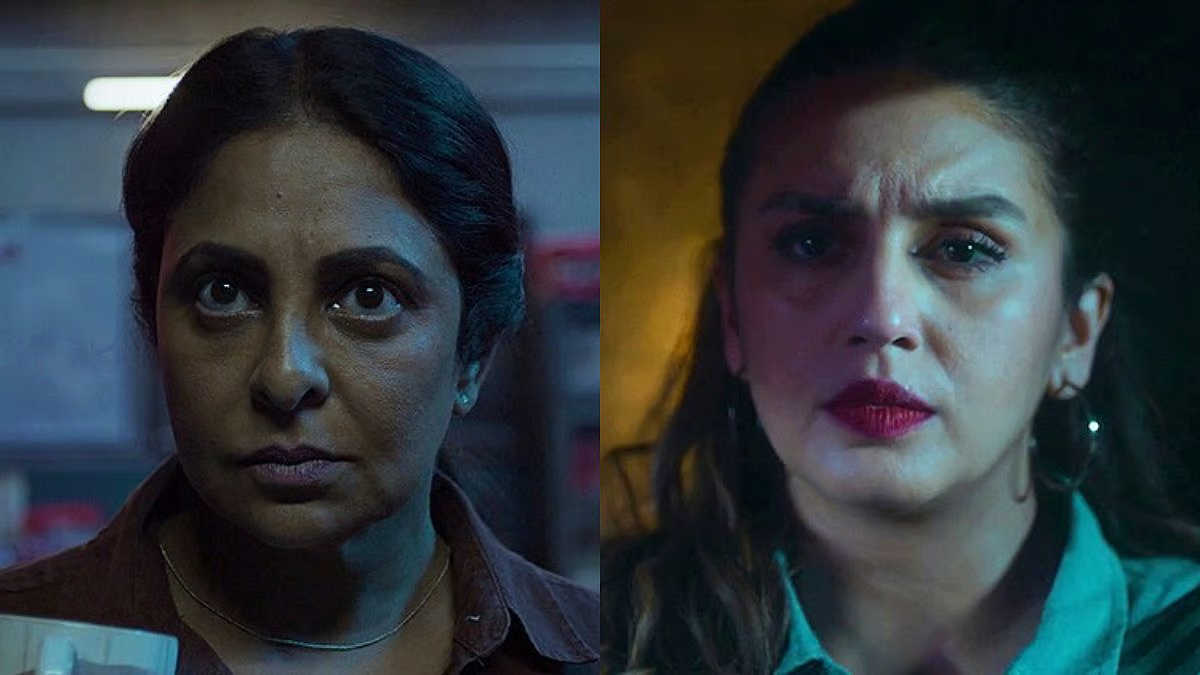
Season 3 of Delhi Crime delivers a gripping, emotionally intense story that dives deep into the dark world of human trafficking and the lasting impact of childhood trauma. At the heart of this season is the tense face-off between DCP Vartika Chaturvedi, played by Shefali Shah, and Meena, aka Badi Didi, portrayed by Huma Qureshi. The finale leaves viewers questioning morality, justice, and the blurred lines between victim and perpetrator.
The Investigation That Leads to Meena
DCP Vartika Chaturvedi is tasked with investigating a harrowing case involving young girls from the Northeast being trafficked across states. The story kicks off when a severely injured toddler, Baby Noor, arrives at a Delhi hospital, revealing the massive scale of the criminal network.
Vartika’s investigation eventually uncovers a human trafficking ring led by Meena, whose operations are a mix of cunning strategy and ruthless violence.
Meena’s Character Depth:
- Not a one-dimensional villain — her traumatic past shaped her actions.
- Experienced abuse in childhood, lost her twin sister, endured early forced marriage, and exploitation.
- Justifies her crimes as “running a business,” offering “opportunities” to girls, even while committing morally reprehensible acts.
This background provides viewers with a nuanced perspective of Meena, showing how trauma and circumstance can shape a person’s choices.
As the investigation deepens, what makes this case particularly unsettling for DCP Vartika is not just the brutality of the crimes, but the sheer scale and organization behind them. This is not an isolated incident or a small criminal gang—it is a well-structured network that spans multiple states, operates with chilling efficiency, and thrives on invisibility. The traffickers exploit gaps in law enforcement, social vulnerabilities, and systemic negligence to continue their operations without attracting attention for long periods. Each new lead that Vartika uncovers reveals another layer of complexity, forcing her team to constantly adapt their strategy.
The case also places immense emotional strain on the officers involved. Unlike conventional crimes, this investigation involves children—innocent lives caught in a web of exploitation they cannot understand or escape. Every rescue mission, every interrogation, and every discovery carries an emotional weight that begins to affect Vartika personally. She is not just solving a case; she is confronting a reality where justice often arrives too late for many victims. This emotional dimension adds urgency to her pursuit of Meena, making the mission deeply personal rather than purely professional.
The Climactic Confrontation
The finale reaches its peak when Vartika finally corners Meena. The tension is palpable in their face-to-face encounter:
- Meena asks: “Will you shoot me?”
- Vartika responds: “I’ll do whatever is right.”
This exchange reflects the moral weight on Vartika’s shoulders — balancing law, justice, and conscience.
Meena’s Confession:
- She recounts her traumatic childhood and abuse.
- Blames societal failures and the system for her choices.
- Challenges Vartika’s moral stance, attempting to blur the lines between victim and criminal.
The final confrontation between Vartika and Meena is not merely a physical showdown; it is an ideological clash between two vastly different worldviews. Meena represents a distorted survival instinct shaped by years of trauma, while Vartika embodies the rule of law and the belief in justice. Their interaction is intense because it is not driven by hatred alone—it is driven by understanding, conflict, and moral tension.
What makes this moment particularly powerful is the absence of clear emotional boundaries. Vartika is not facing a stereotypical villain devoid of humanity. Instead, she is confronting someone who has suffered deeply, someone whose pain is real and undeniable. This forces Vartika to confront uncomfortable questions: Can empathy coexist with justice? Does understanding someone’s trauma change how their crimes should be judged? These questions linger in the air as the two women face each other, making the scene far more layered than a typical confrontation.
Does DCP Vartika Kill Meena?
Yes. In the climax, Vartika shoots Meena after Meena becomes aggressive following her accomplice Vijay’s death. Both Meena and Vijay die in the shootout, effectively ending the trafficking network.
Key Takeaways:
- The series emphasizes accountability and the protection of innocent lives.
- Vartika’s decisive action highlights the moral dilemmas law enforcement faces when trauma and crime intersect.
While the answer is clear in terms of plot, the significance of Vartika’s action lies in its moral implications. The decision to shoot Meena is not portrayed as a moment of triumph or victory. Instead, it is depicted as a necessary but deeply troubling choice—one that carries emotional consequences. Vartika does not celebrate the end of Meena; she processes it with a sense of gravity, fully aware that the situation could have been different under other circumstances.
This moment underscores the harsh realities of law enforcement, where decisions must often be made in seconds, with lives hanging in the balance. Vartika’s choice reflects her responsibility to protect others, even if it means taking a life. However, the series makes it clear that such decisions are never simple. They leave behind questions, doubts, and emotional scars that cannot be easily resolved.
What Meena Tells Vartika
Meena delivers crucial lines that challenge Vartika and the audience:
- Claims the law alone cannot stop systemic exploitation.
- Suggests real criminality lies in societal neglect and structural failures.
- Confesses her own victimhood and frames her actions as survival.
Vartika listens but remains firm: the exploitation of children and vulnerable people is indefensible, regardless of personal history. This confrontation forms the ethical core of the season.
Meena’s dialogue serves as the philosophical backbone of the finale. Her words force both Vartika and the audience to confront uncomfortable truths about society. She speaks about neglect, abandonment, and the lack of opportunities that push individuals toward desperate choices. In her view, the system failed her long before she became a criminal.
What makes her argument compelling is its partial truth. The series does not dismiss her experiences; it acknowledges them. However, it also refuses to accept her justification for exploiting others. This duality creates a powerful tension—Meena is both a victim and a perpetrator, someone who has suffered but also caused immense suffering.
Vartika’s response is equally significant. She listens without dismissing Meena’s pain, but she does not allow it to excuse the harm inflicted on innocent lives. This balance between empathy and accountability is central to the series’ message. It suggests that understanding someone’s past does not absolve them of responsibility for their actions.
The Final Moments and Hope
After the shootout, the focus shifts to Khushi, a young girl previously involved in the network but showing signs of wanting to change. Authorities decide to send her to a shelter for rehabilitation rather than punishment.
In a touching exchange:
- Khushi asks Vartika: “What do you see in me?”
- Vartika replies: “Hope.”
This moment underlines the season’s message: while crime and darkness exist, hope, change, and rehabilitation are possible.
The closing scenes of the season shift the tone from confrontation to reflection. After the intensity of the climax, the focus on Khushi offers a sense of emotional relief and cautious optimism. Her journey represents a different path—one where intervention, support, and care can lead to change.
Khushi’s character is significant because she stands at a crossroads. She has been exposed to the same environment that shaped Meena, but she still has the opportunity to choose a different future. By choosing rehabilitation over punishment, the authorities acknowledge the importance of addressing not just the crime but the circumstances that led to it.
Vartika’s interaction with Khushi is subtle yet powerful. It reflects her belief that not all individuals caught in such systems are beyond redemption. This perspective adds depth to her character, showing that she is not just focused on enforcing the law but also on protecting and guiding those who can still be saved.
Themes and Significance
Season 3 of Delhi Crime is more than a crime thriller — it is a meditation on morality, justice, and the cyclical nature of trauma.
Core Themes:
- Confrontation between law and exploitation.
- Criminality often stems from neglect and abuse.
- Moral responsibility does not disappear because someone’s life was hard.
- Justice is complex, requiring both empathy and accountability.
The series also acknowledges that systemic issues persist beyond individual criminals. By highlighting Khushi’s rehabilitation, it reinforces the possibility of breaking cycles of violence and exploitation.
One of the most compelling aspects of Season 3 is its exploration of systemic issues rather than isolated crimes. The series emphasizes that human trafficking is not just a criminal activity—it is a social problem rooted in inequality, lack of education, and institutional gaps. By highlighting these factors, the narrative moves beyond surface-level storytelling and delves into the deeper causes of exploitation.
Another important theme is the psychological impact of trauma. Meena’s character illustrates how unresolved pain can manifest in destructive ways. At the same time, Khushi’s story shows that early intervention can prevent this cycle from continuing. Together, these narratives create a comprehensive view of how trauma shapes lives in different directions.
The series also examines the role of law enforcement in addressing such issues. While the police can dismantle networks and rescue victims, they operate within a system that has limitations. This acknowledgment adds realism to the story, preventing it from becoming overly idealistic.
Conclusion
The ending of Delhi Crime Season 3 delivers both closure and moral reflection. Vartika brings Meena to justice, affirming the law while navigating the emotional complexities of trauma. Meena’s confession adds depth to the narrative, exposing systemic failures and the roots of criminal behavior.
The series ends on a hopeful note with Khushi’s rehabilitation, emphasizing that even in the darkest circumstances, change is possible. Season 3 stands out as a gripping, morally intricate addition to the Delhi Crime franchise, offering a compelling exploration of justice, human complexity, and the fight against systemic evil.